







Gilgamesh: The Original Advocate for Healthy Life Extension
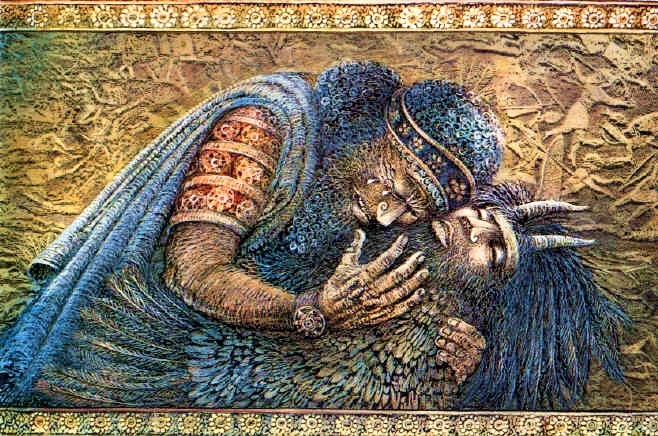
The Epic of Gilgamesh is an ancient Mesopotamian poem that is widely considered humanity’s oldest surviving great work of literature. It tells the tale of Gilgamesh, king of the city Uruk, and how the tragic loss of his beloved friend Enkidu sets him on a quest to overcome the diseases of old age and death.
 |  | |
After many fantastic experiences, including meeting his immortal ancestor Utnapishtim (prototype of the biblical Noah), Gilgamesh finds, but ultimately fails to use, a flower that can bring rejuvenation. While not achieving his goal in a literal sense, the wisdom Gilgamesh gains on his journey allows him to become a truly wise and just king, and thus achieve a different sort of immortality.
The story is a prime example of the “Monomyth” Hero’s Journey, as described by Joseph Campbell’s “The Hero With a Thousand Faces”, and in many ways set the standard for the more well-known Epics that followed.
 |  |  | ||
A Hero’s Journey
In the story, Enkidu was created by the Gods as a rival to Gilgamesh, who they thought had become too powerful. Their plans backfired when the two would-be rivals became true friends, going on a variety of adventures together. In one such adventure, they slayed the monster Humbaba which lurked in the Cedar forest. The Gods were angered, and sent the mighty Bull of Heaven to Earth, who slayed many hundreds in its rage, but eventually Enkidu and Gilgamesh defeated it. For this, Enkidu is condemned to death by the Gods. Losing his friend in this way causes Gilgamesh to embark on an epic journey to stop this from ever happening again. And this quest to heal the frail and the sick is what leads him to the flower of rejuvenation, the Lycium.
As Gilgamesh embarked on his perilous journey, he traversed treacherous mountains and vast deserts, and faced many challenges along the way, encountering mythical creatures and battling fierce monsters.
 With each step he took, Gilgamesh’s determination grew stronger, fueled by his unwavering love for his fallen friend Enkidu. Gilgamesh pressed on, his heart filled with hope and his mind focused on his noble quest. Along his journey, he encountered wise elders who imparted valuable knowledge and taught him the importance of humility and compassion.
As he ventured deeper into uncharted territories, Gilgamesh’s character transformed. He shed his arrogance and embraced his vulnerability, understanding that true strength lies not in physical prowess alone, but in the ability to empathize with others and offer a helping hand.
He formed unlikely alliances and forged unbreakable bonds, realizing that the journey itself was just as important as the destination.
Finally, after what felt like an eternity, Gilgamesh find the Lycium. Its vibrant petals shimmered with an otherworldly glow, promising the gift of renewed youth and vitality. With trembling hands, he plucked the flower, its delicate fragrance filling the air.
Gilgamesh forgoes ingesting the flower immediately, deciding instead to take it back to Uruk to share with his people.
But before he arrives back at Uruk, however, he stops to rest a while and makes camp by the roadside, where suddenly a giant snake appears and snatches away the Lycium. Gilgamesh dashes after the serpent, grabbing it by the throat, but it sheds its skin and escapes. As it flees from the hero it turns into a young snake once more, showing that indeed the Lycium did hold the power of rejuvenation.
While not achieving his goal, the wisdom Gilgamesh gained on his journey allowed him to return and rule as a truly wise and just king. For that reason, his legacy has lived on as a symbol of resilience, compassion, and the enduring power of the human spirit.
We may succeed where Gilgamesh failed
In many ways Gilgamesh can be considered the original advocate of healthy life extension. His is a story that inspired us to launch Lifespan.io and support the development of technology for rejuvenation and longevity.
While Gilgamesh’s quest to overcome aging can certainly be considered metaphorically, it is still an important context to note that such desires and ideas have been part of our collective thought process since the literal beginning of human history. While ultimately his quest ended in failure in the biological sense, we have the opportunity to continue that journey and this time see it through to the end.
The research we support is simply the most recent link in a very long chain of human compassion and desire. It is for this reason that we have chosen to name the patron levels in our Lifespan Heroes program after key locations on Gilgamesh’s journey.
 | The Gateway represents the start of the hero’s journey. Specifically that of the first hero, Gilgamesh, as he passed through the gates of the city Uruk on his quest to overcome the diseases of aging and death. By joining us we can carry this quest forward together, and help bring healthier and longer lives to everyone. | |
 | The Cedar represents the long-lived trees and forest animals of the world. In the story of Gilgamesh the Cedar Forest is where key events unfold that lead to the sickness and death of Gilgamesh’s beloved friend Enkidu, the trauma of which sends him on his quest. | |
 | The Mountain represents endurance, and the hard work that must be done to reach noble goals. In the story of Gilgamesh he must race the sun through the mountain Mashu, risking being consumed by its flames — a powerful metaphor that time is precious indeed. | |
 | The Ocean represents the waters of life and the long-lived creates of the sea. In the story of Gilgamesh he journeys to the bottom of the ocean to find the flower of rejuvenation — one that can make you ‘be again as you were in your youth’. | |
 | The Lycium represents the flower of rejuvenation Gilgamesh sought in his quest to overcome the diseases of aging. While he did not succeed, together we can carry the spirit of this quest with science, and work to fulfill the noble goal of healthy lifespans for all. |