
A recent review evaluated studies that included over 5.5 million participants to assess the impact of multivitamin and mineral supplements on different aspects of health [1].
A big market
Multivitamin and mineral (MVM) supplements are widely used worldwide, and in the United States, around 40% of adults report taking MVMs regularly [2]. While there is scientific evidence regarding the beneficial effects of individual vitamins or micronutrients on health, the role of MVMs in lifespan and longevity remains to be evaluated.
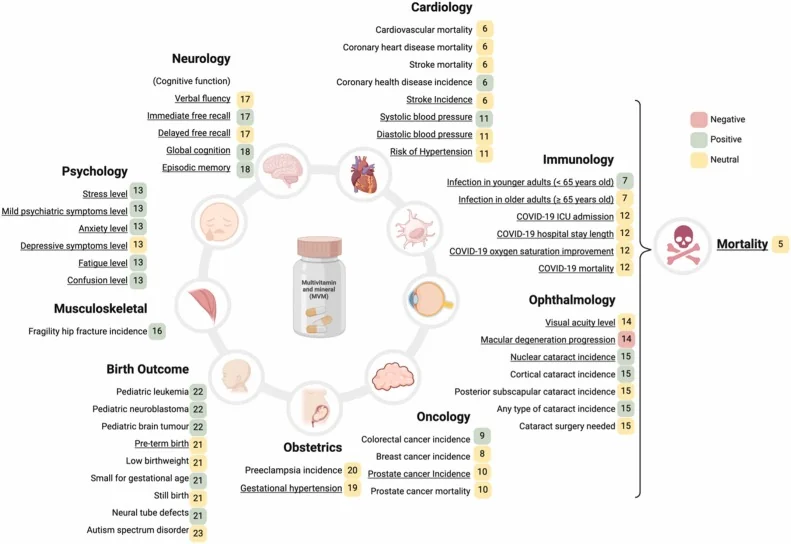
Andrea Maier, whom we recently interviewed, and her team conducted a review to assess findings from 19 meta-analyses published in the last 25 years on the impact of MVMs on different aspects of health, with each study analyzing data from a few thousand to almost a million participants. While the analysis showed no effect of MVM supplementation on all-cause mortality, it did affect the risks and progression of various health conditions.
Impacting disease risk
The researchers began by examining the impact of MVM supplements on cancer. They noted that seven prospective cohort studies suggest a protective effect of MVM supplementation against colorectal cancer, with an 8% lower incidence among supplement users. However, no association was observed between MVM supplementation and breast cancer incidence, prostate cancer incidence, advanced/metastatic prostate cancer, or prostate cancer mortality.
Similarly, the pooled analysis of 16 cohort studies found no significant association between MVM use and cardiovascular disease mortality, coronary heart disease mortality, stroke mortality, or stroke incidence. This analysis, however, showed a lower risk of coronary heart disease incidence, but two randomized controlled trials (RCTs) didn’t support this association. Additional evidence for cardiovascular disease came from a set of 12 RCTs, which suggested “MVM intake lowers blood pressure in individuals with hypertension or chronic disease but has little effect in normotensive individuals and does not prevent hypertension.”
Differences by subgroup were also observed regarding infections. While no significant effect of MVM supplementation on infection rates was found in healthy people 65 and older, among people under 65, MVM supplementation was associated with fewer infections. Similarly, MVM supplementation for at least 6 months in older, undernourished people reduced the number of infections. Two RCTs that focused explicitly on COVID-19 infection found no effect of MVM supplementation on COVID-19 outcomes in hospitalized patients.
Regarding psychological health, the researchers reported positive effects of MVM supplementation, with studies showing that MVM supplementation reduces stress, mild psychiatric symptoms, anxiety, and fatigue in healthy adults, but not depression. The effectiveness was robust for supplements with high doses of B vitamins.
An additional positive impact of MVMs was observed on cognition and musculoskeletal health. Studies reported that MVM supplementation benefits global cognition and measures of cognitive performance, such as immediate free recall and episodic memory, and is associated with a lower risk of fragility-related hip fractures.
There was also one negative observation. When 13 RCTs of peopple aged 42-89 years old with varying stages of age-related macular degeneration were analyzed, the researchers reported that “MVM supplementation does not improve visual acuity and increases the risk of progression to late age-related macular degeneration.” Data from different vision-related studies were more positive, suggesting that MVM supplementation is associated with a lower risk of cataracts (according to observational findings). RCTs also suggest a protective effect, but only for one cataract subtype, nuclear cataracts, in older adults.
Pregnancy
While many studies exclude pregnant women, studies on MVM supplementation analyzed the MVM supplementation during pregnancy and its outcomes. They observed that there was no association between MVM supplementation containing folic acid and the risk of gestational hypertension or preeclampsia in observational studies. However, RCTs suggest a protective effect.

Studies suggest no significant effect of MVM supplementation on preterm birth, low birth weight, and stillbirth. Observational studies differed from RCTs regarding small-for-gestational-age births, in which observational studies, but not RCTs, suggest a protective effect of MVM supplementation. Observational studies also found a significant association between MVM supplementation and a lower risk of neural tube defects, congenital cardiovascular defects, urinary tract defects, and limb deficiencies, but not of Trisomy 21.
Additionally, children of mothers who took MVMs before or during pregnancy suggest that prenatal MVM supplementation is positively associated with reduced risk of specific pediatric cancers (leukemia, brain tumors, and neuroblastoma), and there is a possible protective effect of prenatal MVM use against autism spectrum disorder in offspring according to some, but not all, studies.
The need for a standardized definition
The overall results indicate that MVM supplementation can be beneficial in specific populations or for particular conditions, suggesting that multiple variables, such as age, sex, health status, dietary intake, and food frequency, should be taken into account when recommending MVMs. The authors point out that nutritional deficiencies should receive special attention, as deficiencies in specific nutrients can lead to health problems and accelerated aging [3].
Other studies also suggest that “nutritional status may modify the response to supplementation,” and the benefits of supplementation can be more pronounced in individuals with lower dietary quality [4]. Stratifying study participants into subgroups based on different factors might help identify those most likely to benefit from supplementation. However, as the reviewers conclude, “the value of MVM supplementation in optimizing the health and healthspan of relatively healthy individuals remains uncertain.”
Analysis of multiple studies also highlighted general limitations and improvements needed when conducting MVM studies. One of the most significant problems in this field is the lack of standardized definitions of what qualifies for MVM supplements, which vitamins and minerals should be included, and in what quantities. Lack of definition can result in inconsistencies in study outcomes and makes comparing studies more challenging, since MVMs in various studies can have different compositions. Additionally, some studies use self-reported questionnaires to gather information, which often lack information about the type of supplement used.
There is also a possibility that some studies on MVMs, especially observational cohorts that recruit self-selected supplement users, suffer from “healthy user effect.” The cohorts in those studies might contain more health-conscious individuals, who are interested in taking supplements and engaging in other health-oriented behaviors, making the samples of MVM supplement users not representative of the general population. Such cohorts might be lacking participants who might benefit the most from MVM supplementation: less health-conscious people who might have nutritional deficiencies.
Literature
[1] Lou, C., Wang, G., Xiong, Z., Jiang, Y. C., Li, Y., Zhu, M., Yang, H., Wang, L., He, L., Chang, H. M., Wang, J., Zhu, W., Dong, X., Li, T. Y., Yuan, S., Zhao, Y., & Mu, L. (2025). Association of female reproductive traits with altered aging trajectories: Insights from genetic and observational analyses. Cell reports. Medicine, 6(12), 102481.
[2] Knippen, K. L., Mahas, R., & Van Wasshenova, E. (2020). Outcome Expectancies, Health Information Seeking, and Cancer Beliefs Associated with Multivitamin/Mineral Use in a National Sample, HINTS-FDA 2015. Journal of the Academy of Nutrition and Dietetics, 120(8), 1368–1376.
[3] Mahadzir, M. D. A., Tan, S., Elena, S., Chin, E. M., Garg, V., Mantantzis, K., Péter, S., & Maier, A. B. (2025). Towards defining optimal concentrations of micronutrients in adults to optimize health. Mechanisms of ageing and development, 225, 112062.
[4] Rautiainen, S., Gaziano, J. M., Christen, W. G., Bubes, V., Kotler, G., Glynn, R. J., Manson, J. E., Buring, J. E., & Sesso, H. D. (2017). Effect of Baseline Nutritional Status on Long-term Multivitamin Use and Cardiovascular Disease Risk: A Secondary Analysis of the Physicians’ Health Study II Randomized Clinical Trial. JAMA cardiology, 2(6), 617–625.