The Conboy lab in Berkeley has discovered a treatment combination that greatly extends lifespan in old male mice and published its findings in Aging.
A combination with systemic effects
The researchers begin this paper with a discussion of well-known interventions and their drawbacks. For example, they note that while rapamycin is effective in extending the lifespans of mice [1], it is associated with cancer development [2]; while adding the anti-cancer drug trametinib mitigates this issue [3], this combination strongly inhibits mTOR, which is necessary for stem cell and brain function [4]. Similarly, knocking out the interleukin IL-11 extends lifespan in mice [5], but its levels only increase with severe disease [6] and it plays a major part in ovarian health [7].
Therefore, these researchers have built on their previous work involving the systemic environment. The Conboy lab is most famous for its work on heterochronic parabiosis and therapeutic plasma exchange, which remove harmful compounds from the bloodstream that accumulate with age [8]. However, such an approach involves repeatedly replacing a person’s blood, which comes with its own complications [9].
This experiment involves attempting to recapitulate the benefits of TPE by addressing its key molecular determinants. This team found two that it deemed likely to work in conjunction: oxytocin, a well-known compound involved in social bonding [10] and is crucial in healing and metabolism [11], and A5i, a compound that inhibits the age-related increase of TGF-β, a factor that promotes fibrosis and inflammation [12]. This lab’s previous work has found that this combination, OT+A5i, leads to tissue rejuvenation [13], and so it performed another experiment involving lifespan.
Sex-dependent effects
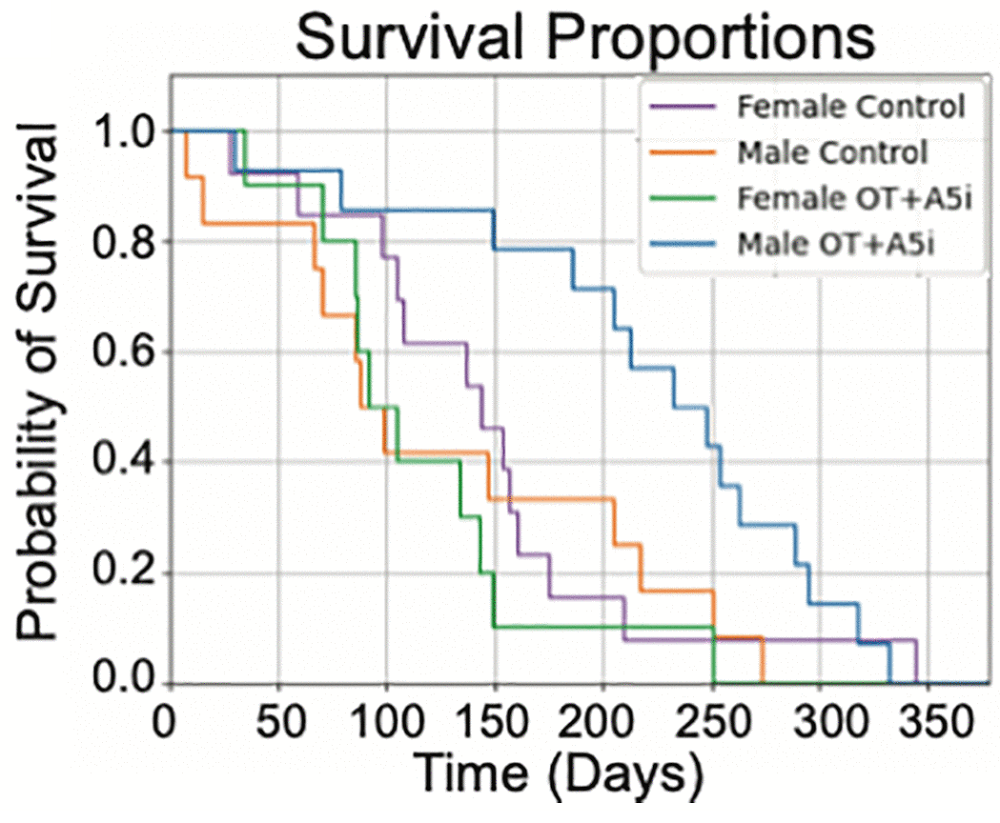
The researchers’ lifespan experiment involved four separate groups of males and females either receiving OT+A5i or serving as controls, each of which contained roughly a dozen animals. These mice, at 25 months of age, were already old and frail at the beginning of the study. For two weeks, they would be given this combination three times a week, then left for two weeks without the combination before they were physiologically assessed and the treatment cycle was repeated.
In male mice, the gains in lifespan were tremendous. While their lifespans were only increased by an average of 14% as measured from birth, they were increased by 74% as measured from the beginning of treatment. Six months after treatment, more than three quarters of the treated male mice were still alive, while only about a third of the male mice in the control group had survived this long.
Unfortunately, there were no benefits for lifespan in female mice. The survival curves of the controls and OT+A5i female mice looked similar, with a trend towards a decrease in lifespan instead.
The researchers further assessed this combination’s effects on frailty. They found that OT+A5i improved healthspan as well as lifespan, increasing the time before the animals reached a certain threshold of assessed frailty according to multiple physical measurements, such as vision, gait, and physical challenges such as treadmill and limb hanging times. Additionally, the treated males were more likely to live longer even after becoming frail.
There were clear effects on the individual metrics used to assess frailty as well. The treated male mice were much more able to recognize novel objects, run for longer on gradually accelerating treadmills, and hang for longer from a wire ceiling. Similarly to the lifespan study, none of these beneficial effects on healthspan were found on old female mice.
Only short-term effects on females
These sex-dependent results appear to have been due to a lack of long-term efficacy in females. Immediately after administration of OT+A5i, the researchers discovered that both male and female mice began to synthesize a more youthful balance of proteins (the proteome). Proteomic noise was also, in the short term, decreased by OT+A5i in both sexes. However, these effects were attenuated in females but not males after four months of treatment.

The researchers note that oxytocin is already approved for clinical use by the FDA and that A5i drugs are already being investigated for the treatment of certain conditions, with no major adverse effects yet reported in clinical trials. Therefore, it would be logical to begin a clinical trial to investigate what, if any, effects that this combination may have on the lifespan and healthspan of older men.
Literature
[1] Bjedov, I., & Rallis, C. (2020). The target of rapamycin signalling pathway in ageing and lifespan regulation. Genes, 11(9), 1043.
[2] Bitto, A., Ito, T. K., Pineda, V. V., LeTexier, N. J., Huang, H. Z., Sutlief, E., … & Kaeberlein, M. (2016). Transient rapamycin treatment can increase lifespan and healthspan in middle-aged mice. elife, 5, e16351.
[3] Gkioni, L., Nespital, T., Baghdadi, M., Monzó, C., Bali, J., Nassr, T., … & Partridge, L. (2025). The geroprotectors trametinib and rapamycin combine additively to extend mouse healthspan and lifespan. Nature Aging, 1-17.
[4] Garza-Lombó, C., Schroder, A., Reyes-Reyes, E. M., & Franco, R. (2018). mTOR/AMPK signaling in the brain: Cell metabolism, proteostasis and survival. Current opinion in toxicology, 8, 102-110.
[5] Widjaja, A. A., Lim, W. W., Viswanathan, S., Chothani, S., Corden, B., Dasan, C. M., … & Cook, S. A. (2024). Inhibition of IL-11 signalling extends mammalian healthspan and lifespan. Nature, 632(8023), 157-165.
[6] Ren, C., Chen, Y., Han, C., Fu, D., & Chen, H. (2014). Plasma interleukin-11 (IL-11) levels have diagnostic and prognostic roles in patients with pancreatic cancer. Tumor Biology, 35(11), 11467-11472.
[7] Cork, B. A., Li, T. C., Warren, M. A., & Laird, S. M. (2001). Interleukin-11 (IL-11) in human endometrium: expression throughout the menstrual cycle and the effects of cytokines on endometrial IL-11 production in vitro. Journal of reproductive immunology, 50(1), 3-17.
[8] Kim, D., Kiprov, D. D., Luellen, C., Lieb, M., Liu, C., Watanabe, E., … & Conboy, I. M. (2022). Old plasma dilution reduces human biological age: a clinical study. Geroscience, 44(6), 2701-2720.
[9] Mokrzycki, M. H., & Kaplan, A. A. (1994). Therapeutic plasma exchange: complications and management. American Journal of Kidney Diseases, 23(6), 817-827.
[10] Zeki, S. (2007). The neurobiology of love. FEBS letters, 581(14), 2575-2579.
[11] Breuil, V., Trojani, M. C., & Ez-Zoubir, A. (2021). Oxytocin and bone: review and perspectives. International journal of molecular sciences, 22(16), 8551.
[12] Tzavlaki, K., & Moustakas, A. (2020). TGF-β Signaling. Biomolecules, 10(3), 487.
[13] Mehdipour, M., Etienne, J., Chen, C. C., Gathwala, R., Rehman, M., Kato, C., … & Conboy, I. M. (2019). Rejuvenation of brain, liver and muscle by simultaneous pharmacological modulation of two signaling determinants, that change in opposite directions with age. Aging (Albany NY), 11(15), 5628.